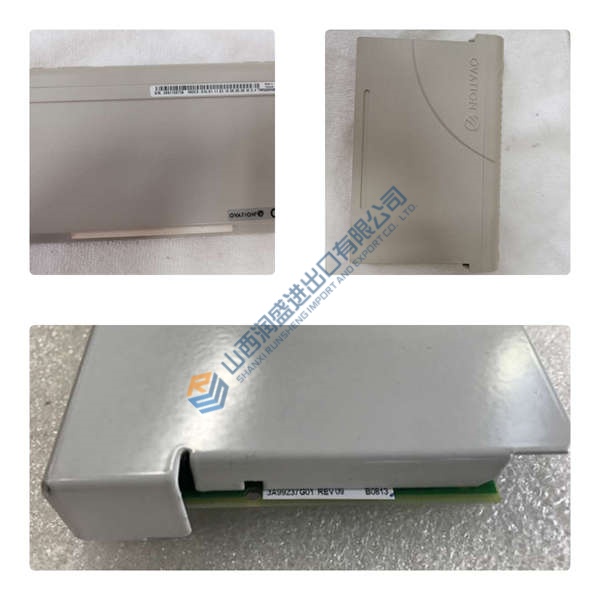
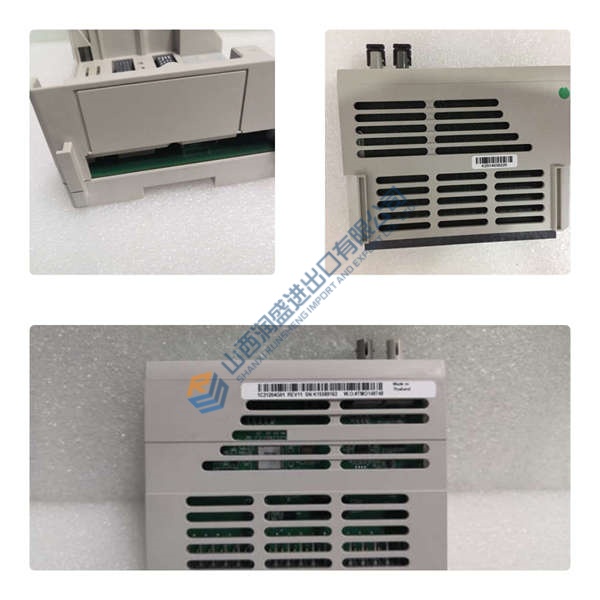
Description
Key Technical Specifications
-
Product Model: DCC2223A 3EST125-977
-
Manufacturer: Bombardier
-
System Platform: Mitrac Traction Converter
-
Supply Voltage: 24V DC (Nominal input from local power supply)
-
Gate Output Voltage: +15V / -10V (Typical for high-power IGBTs to ensure robust latch-up immunity)
-
Peak Gate Current: >15A (Designed for large gate charge capacity modules)
-
Signal Interface: Fiber Optic (HFBR series) or Hardwired (depending on sub-revision)
-
Insulation Rating: Basic insulation for 1200V/1700V DC Link applications
-
Short Circuit Protection: $V_{CE}$ Monitoring with Soft Shut-Down (SSD) capability
-
Dead Time Interlock: Hardware-implemented lockout prevents bridge shoot-through
-
Operating Temperature: -40°C to +85°C (Class Tx per EN 50155)
-
Board Coating: Conformal Coated (Class PC2) for humidity and pollution resistance
-
Dimensions: Standard Eurocard format or custom Bombardier footprint
-
Applicable Standard: EN 50155 (Electronic equipment used on rolling stock)
Technical Architecture & Functional Positioning
Architecture Analysis
The DCC2223A functions as the “muscles” of the traction control system. While the main Traction Control Unit (TCU) acts as the brain, calculating vector control algorithms and torque requests, it operates at low voltage (typically 5V logic). The DCC2223A bridges the gap between this delicate logic level and the high-energy silicon of the IGBTs (Insulated Gate Bipolar Transistors) that manage megawatt-level power flows.
Technically, this module utilizes a high-frequency DC-DC converter stage to generate isolated power supplies for the gate driving circuitry. This ensures that the high-voltage potential of the traction circuit (which can fluctuate between 600V and 3000V depending on the line voltage) does not feed back into the low-voltage control cabinet. The core technology involves “Soft Turn-Off” (STO) protection. In the event of a load short-circuit, simply cutting the gate voltage instantly would induce a massive voltage spike ($V = L \times di/dt$) capable of destroying the IGBT. The DCC2223A detects the rise in Collector-Emitter voltage and slowly reduces the gate voltage, dissipating the energy safely.
From an engineering value perspective, the specific tuning of the 3EST125-977 variant—specifically its gate resistors and timing capacitors—is matched to specific IGBT characteristics (often Mitsubishi or Infineon modules). This precise matching minimizes switching losses (heat) while keeping electromagnetic interference (EMI) within limits, preventing noise from disrupting adjacent signaling or communication systems on the train.
Typical Application Scenarios
-
Urban Metro Systems: Driving the Variable Voltage Variable Frequency (VVVF) inverters in subway cars, managing frequent acceleration and braking cycles.
-
Light Rail Vehicles (LRVs): Controlling the traction phases in tramways, often involving 750V DC catenary systems.
-
Braking Choppers: Controlling the dissipation of regenerated braking energy into rheostats when the overhead line cannot accept power.
-
Auxiliary Converters: Acting as the driver for the inverters that generate 3-phase 400V AC for train air conditioning and compressors.
Quality Standards & Testing Procedures
Quality Philosophy
In the railway sector, “reliability” is not just a metric; it is an operational necessity. A single failed gate driver can disable a motor boogie, reducing traction power and potentially taking a train out of service during peak hours. Our quality assurance process treats every DCC2223A as a safety-critical component, subjecting it to testing protocols that exceed standard industrial requirements.
Standardized Testing Protocol (SOP)
Visual & Structural Audit
Every board undergoes a microscopic inspection to detect stress fractures in the PCB substrate, particularly around mounting holes and heavy transformers. We check for “dendrite growth” or corrosion on traces caused by years of operation in humid environments. All old electrolytic capacitors—which have a finite lifespan—are systematically replaced with high-temperature, long-life equivalents (105°C rated).
High-Voltage Pulse Testing
We do not just check if the board powers up; we test its dynamic performance.
-
Double-Pulse Test: We subject the driver to a double-pulse test sequence to verify turn-on and turn-off characteristics. We measure the rise time ($t_r$) and fall time ($t_f$) of the gate pulse to ensure they fall within the specific nanosecond range required by the 3EST125-977 specification.
-
Isolation Verification: The galvanic isolation barrier is tested using a Hi-Pot tester to ensure there is no leakage current between the low-voltage interface and the high-voltage output stage, critical for safety.
Protection Logic Simulation
The most vital function of this board is protection. We simulate fault conditions by artificially clamping the feedback lines to mimic a shorted IGBT. The board must demonstrate:
-
Desaturation Detection: Triggering within typically <10 microseconds.
-
Fault Latching: Holding the fault signal to the controller until a reset command is issued.
-
Soft Shut-Down: Verifying the gate voltage ramps down rather than dropping instantly.
Environmental Stress Screening
Refurbished units are subjected to thermal cycling (-20°C to +60°C) while powered to trigger any latent defects in solder joints or semiconductor bonds that typically fail under thermal expansion stress.
Compatibility & Installation Maintenance Guide
Engineering Notes
The DCC2223A is part of a modular ecosystem. While many Bombardier cards look similar, the specific suffix -977 defines critical operational parameters.
Pre-Replacement Checklist
-
Hardware Revision Match: Check the revision letter (e.g., Rev C, Rev D) etched on the PCB. While newer revisions are often backward compatible, older revisions may not support newer IGBT generations with different gate charge requirements.
-
Gate Resistor ($R_g$) Integrity: This board likely connects to external or board-mounted gate resistors. Measure these resistors before installation. A drifted resistor value can cause oscillation (ringing) in the gate signal or slow switching that overheats the IGBT.
-
Fiber Optic Handling: If this variant uses fiber optic control links (Agilent/Avago HFBR series), inspect the cable ends for scratches. Do not bend fiber cables below their minimum radius (typically 30mm), as this causes light attenuation and signal dropouts (jitter).
Electrostatic Discharge (ESD) Protection
The CMOS logic on board is highly sensitive. Technicians must utilize grounded wrist straps and ESD-safe mats. Never transport the board in standard bubble wrap; use conductive shielding bags.
System Compatibility Verification
Ensure the main Traction Control Unit (TCU) software is configured for the specific IGBTs being driven. If you are replacing the IGBT power modules alongside this driver, ensure the DCC2223A version is compatible with the new IGBT’s input capacitance ($C_{ies}$).
Our Service & Commitment
We offer more than just spare parts; we offer a solution to obsolescence. The DCC2223A is often found in trains that have been in service for 15+ years. Manufacturers may discontinue support, but we bridge that gap.
Our team comprises engineers with deep knowledge of the Mitrac topology. We provide a 12-month verifiable warranty. This is not just a “DOA” (Dead on Arrival) guarantee; it covers the functional performance of the unit under load. If a module fails, our priority is to get a replacement to you immediately to minimize fleet downtime. We also offer exchange programs—send us your repairable core for a credit on a refurbished unit.
Global Supply & Technical Support
Global Reach for Rail Assets
RUNSHENG Automation supports railway operators, maintenance depots, and rolling stock leasing companies across Europe, Asia, and the Americas. We understand the urgency of “AOG” (Aircraft on Ground) style situations in the rail industry.
Obsolescence Management
We specialize in sourcing discontinued Bombardier/Mitrac electronic parts. Our supply chain accesses surplus inventory from decommissioned projects and strategic reserves, ensuring you can maintain your fleet without being forced into costly full-system upgrades.
Fast Logistics
We utilize DHL, FedEx, and specialized freight forwarders to ensure rapid delivery. Customs invoices are prepared with correct HS codes for railway parts to prevent border delays.
Related Products & System Components
Key components working in conjunction with the DCC2223A include:
-
IGBT Power Module: The primary switch (e.g., 1200V or 1700V dual pack) driven by the DCC card.
-
Gate Interface Adapter: A small PCB that may sit between the DCC card and the IGBT terminals to adapt pinouts.
-
Current Sensor (Hall Effect): Monitors output current; the DCC card may use this data for secondary protection.
-
Phase Module Capacitor: Snubber capacitors located near the IGBTs to absorb voltage spikes; degrading snubbers can damage the DCC card.
-
Traction Control Unit (TCU): The rack-mounted CPU (often VME bus) that sends the firing commands to the DCC2223A via fiber or ribbon cable.
ASEA BROWN BOVERI 2284261-V NSPP 2284261V
ASEA BROWN BOVERI 289B456A13 NSPP 289B456A13
ASEA BROWN BOVERI ACS601-0009-4-000B1500801 USPP ACS601
ASEA BROWN BOVERI ACS601-0009-5-000B1500800 USPP ACS601
ASEA BROWN BOVERI YM321001-Z USPP YM321001Z
ASEA BROWN BOVERI DSQC-230 USPP DSQC230
ASEA Brown Boveri, ABB DSPC 153 A
ASEA Brown Boveri, ABB YTEA 250 -8
ASEA Brown Boveri, ABB YTEA 250 -8
ASEA Brown Boveri, ABB YTEA 250 -8
ASEA Brown Boveri, ABB YTEA 250 -8
ASEA BROWN BOVERI A260-30-11-34 NSPP A260301134
ASEA BROWN BOVERI 3HAB7229-1 NSPP 3HAB72291
ASEA BROWN BOVERI YT213001-AB/2 USPP YT213001AB2
ASEA BROWN BOVERI YT213001-AC/2 USPP YT213001AC2
ASEA BROWN BOVERI ACS550-01-012A-4 USPP ACS55001012A4
ASEA BROWN BOVERI OETL-NF600APABB NSPP OETLNF600APABB
ASEA BROWN BOVERI YT204001-FY/1 USPP YT204001FY1
ASEA BROWN BOVERI ACS501-010-4-00P2 USPP ACS501010400P2
ASEA Brown Boveri ABB YM321001-Z Signal PCA PCB NNB
ASEA BROWN BOVERI YB560103-BD NSFP YB560103BD