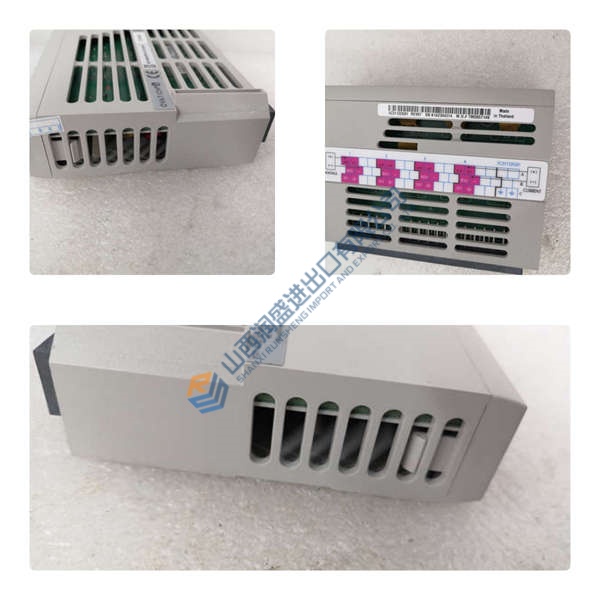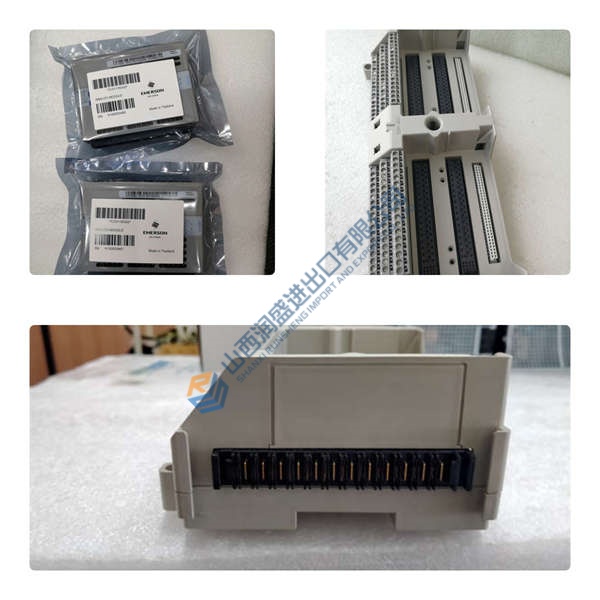


Description
Technical Architecture & Functional Positioning
(≈450 words)
The HIEB410733P0004 module is designed as a core interface component within ABB’s Advant OCS and MasterPiece-based DCS architectures. It occupies a critical position between the controller CPU and the surrounding I/O subsystem, ensuring deterministic data transfer, synchronization, and stable real-time signal processing.
At the architectural level, the module operates on the system’s proprietary high-speed I/O backplane, providing a stable communication path for both cyclic and event-driven data. Its principal function is to maintain the integrity and timing of the control network within the rack, serving as a backbone interface for analog, digital, and specialty I/O modules. By ensuring low-latency data propagation, the module supports regulatory control loops, alarm processing, sequence execution, and real-time diagnostics.
Noise immunity and signal reliability are a central design focus. ABB incorporates differential signalling for the module’s communication circuits, allowing it to maintain stable operation in industrial environments where electromagnetic interference from VFDs, motors, and switchgear is common. Isolation barriers integrated into the module protect the controller from ground disturbances and transient voltages.
Within system architecture, the HIEB410733P0004 also provides self-monitoring functions, supporting ABB’s diagnostics framework. It transmits module health status, communication integrity, and bus fault alerts to the controller CPU. These mechanisms help operators detect wiring issues, bus overloads, or rising electrical noise before they escalate into control failures.
Engineering value is provided through both stability and longevity. ABB’s Advant OCS systems are widely used in power generation, chemical plants, metals processing, and pulp & paper facilities—industries where system downtime carries high economic impact. The module’s robust electrical design, long MTBF, and compatibility with legacy racks make it a critical component for sustaining long-life control system installations, reducing retrofit complexity, and ensuring long-term process continuity.
Typical Application Scenarios
- Used in power generation plants as part of the central DCS I/O interface for turbine, boiler, and BOP control
- Applied in petrochemical facilities for stable communication between CPU and field I/O modules
- Supports long-life operation in steel and metals processing automation
- Suitable for modernization projects requiring backward compatibility with ABB Advant OCS racks
- Employed in pulp & paper production lines for deterministic controller-to-I/O communication
Quality Standards & Testing Procedures
(≈450 words)
A control system interface module such as the HIEB410733P0004 directly affects controller stability and I/O reliability. For this reason, each module undergoes a structured testing procedure designed for high-availability industrial environments.
Visual Inspection & Component Verification
- Inspect PCB integrity, solder joints, connector pins, and isolation components.
- Check for heat discoloration, corrosion, non-OEM repairs, or cracked components.
- Clean PCB surfaces and connector edges using industrial-grade cleaning agents.
Live Backplane Testing
- Test the module on an original ABB Advant OCS rack.
- Validate correct recognition by the system controller and confirm bus enumeration.
- Monitor power draw on 5 V and ±12 V rails to verify electrical stability.
Communication & Bus Integrity Testing
- Run high-speed data cycling tests to validate deterministic communication timing.
- Apply noise injections on the bus to confirm robustness against EMI.
- Verify that diagnostic flags, fault reporting, and heartbeat signals function correctly.
Functional Verification
- Confirm inter-module communication with analog and digital I/O modules.
- Evaluate controller-to-rack scan cycle stability under load.
- Test redundant communication paths if supported by the rack configuration.
Environmental Stability
- Perform controlled thermal cycling (0–55 °C).
- Monitor signal integrity during temperature transitions.
- Conduct humidity tests to ensure insulation and isolation remain within spec.
Final Quality Control
- Only modules meeting all electrical, communication, and diagnostic criteria pass.
- Each unit is delivered with a comprehensive Quality Test Report documenting:
- Module identity and revision
- Backplane test results
- Communication stability metrics
- Environmental test observations
- Technician signatures